A new process can look clear in a meeting and still fail at its first handoff. Someone may not know when to start it, who approves an exception, or what counts as a finished result. Asking those questions before drawing a workflow helps a team design a process people can actually follow.
Use this guide as a process discovery checklist, not a script to ask one person all at once. Start with the owner and the people who do the work. Confirm their answers with the teams that receive the output, then capture disagreements in a worksheet before you settle on a map.
Start with the Purpose and Boundary
These questions keep the new process focused on a real outcome rather than a collection of tasks.
Scope and purpose
- What problem or recurring need makes this process necessary?
- Who needs the result, and what does a successful result look like to them?
- What event starts the process, and what event ends it?
- Which cases, teams, locations, or products are included—and which are excluded?
- Does an existing process already cover part of this work? Where must the two connect?
Record: A one-sentence purpose, a start and end point, the customer of the output, and explicit exclusions. If stakeholders disagree on the boundary, resolve that before mapping the details. A SIPOC diagram is useful here because it shows suppliers, inputs, the high-level process, outputs, and customers together.


Identify the People and Information Involved
Owners and participants
- Who is accountable for the process result and for keeping the process current?
- Who performs each step, and who can act as a backup?
- Who decides when a case is ready to move forward?
- Who must be consulted before a change to the process is approved?
- Who needs visibility into progress without taking part in the work?
Record: One accountable process owner, the roles that perform work, decision makers, backups, and people who only need updates. Avoid assigning a step to “the team” when one role must make the decision.
Inputs and entry criteria
- What request, data, document, or event is required to start?
- Who supplies each input, and in what format does it arrive?
- How do we know an input is complete and usable?
- What happens when required information is missing or contradictory?
Record: Each required input, its source, its minimum quality check, and the path for an incomplete request. This helps prevent work from entering the process before it can progress.
Outputs and exit criteria
- What exactly must the process produce: a decision, record, service, or delivered item?
- Who receives or relies on each output?
- What makes the output complete, accepted, and ready for the next process?
- Where should the final record or evidence be stored?
Record: The output, recipient, acceptance test, and record location. A process is only complete when its recipient can use the result.
Trace the Work Across Teams
Steps and handoffs
- What are the major steps from trigger to completion?
- Which steps can occur in parallel, and which depend on earlier work?
- Where does work move between roles, teams, or systems?
- What information must accompany each handoff, and how does the receiver acknowledge it?
- Where does a request commonly wait, return for rework, or lose context?
Record: A sequence of steps with the role responsible for each one, plus the information passed at every handoff. Use a swimlane diagram when ownership changes across the flow. Its lanes make a missing owner or an overloaded approval role easier to spot.

Decisions and exceptions
- At which points must someone choose between two or more paths?
- What rule or evidence determines the route?
- Which unusual cases occur often enough to need a documented path?
- Who can approve an exception, and how is that decision recorded?
- How is a failed, rejected, or withdrawn case closed or sent back?
Record: Each decision, its rule, the owner of that decision, and the route for common exceptions. Keep rare edge cases in supporting notes if they would make the main map unreadable. A workflow diagram can then show the main path and the decision branches.
Systems and information
- Which systems, forms, or shared documents are used at each step?
- Where is the authoritative record for status and decisions?
- Which information is copied between systems, and who checks it for accuracy?
- What access does each role need, and what should be restricted?
Record: A system beside each step, the source of truth for each important field, and any manual transfer. Do not assume a diagram executes the workflow or synchronizes operational systems; document those integrations separately if they exist.
Define Safeguards and Success Measures
Controls and risks
- What could go wrong at each critical step, and who would notice?
- Which approvals, checks, policies, or regulatory requirements apply?
- What evidence shows that a required check happened?
- How are errors, delays, and control failures escalated?
Record: The risk, control, control owner, evidence, and escalation path for each critical point. Keep the level of detail proportionate to the process: a routine team request and a regulated approval will need different safeguards.
Metrics and review
- How will we know whether the process delivers the intended result?
- What baseline do we have for time, volume, rework, defects, or satisfaction?
- Which leading signal warns us that a case is stuck before a deadline is missed?
- Who reviews results, how often, and what triggers an update to the process?
Record: A small set of measures with definitions, data sources, owners, and review frequency. For example, “cycle time” needs an agreed start and stop event, or different teams will report different numbers.
Copyable Process Discovery Worksheet
Use one row per process. Replace the prompts with concrete answers, and mark an item unconfirmed if participants disagree. The worksheet is a discovery aid; the diagrams and process record can hold the confirmed version.
| Field | Answer to capture |
|---|---|
| Process name and purpose | What problem does it solve? |
| Trigger and end point | When does it start and finish? |
| In scope / out of scope | Which cases are included or excluded? |
| Customer and output | Who receives what, and what counts as accepted? |
| Accountable owner | Who owns the outcome and future updates? |
| Participants and backups | Which roles do the work and cover absences? |
| Inputs and suppliers | What is required, from whom, and with what quality check? |
| Main steps and handoffs | What happens, who hands over, and what travels with the work? |
| Decisions and exceptions | Which rule chooses a route, and who approves deviations? |
| Systems and records | Where is work performed and where is the authoritative record? |
| Controls and evidence | What must be checked and what proof is retained? |
| Measures and review | How is performance measured, by whom, and how often? |
| Open questions | What is still disputed or needs a real-case test? |
For a shared working session, put these fields next to a process map. Creately’s business process management workspace supports process discovery workshops, shared diagrams, and comments so stakeholders can review a current map together.
Turn the Answers into a Usable Process Map
Once participants confirm the worksheet answers, choose a diagram that makes the remaining questions visible. Use SIPOC to check the process boundary, or a swimlane or workflow diagram to discuss handoffs and exceptions. For the diagramming steps, see our process mapping guide.
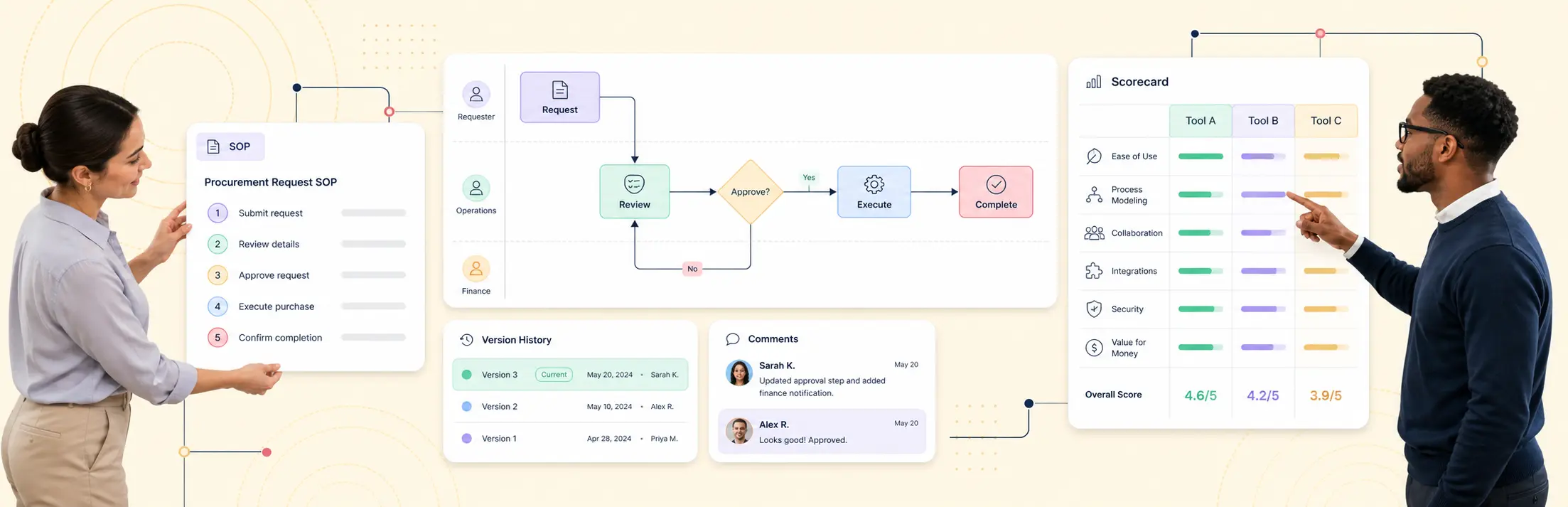
For a new purchase-request process, the discovery answers may identify a complete request as the trigger and an approved or declined decision as the end point. A swimlane view can then expose an unanswered handoff question: who returns requests with missing information to the requester?

Keep Discovery Connected to the Working Process
Creately Process supports SIPOC, swimlanes, flowcharts, and BPMN in a shared process repository. Teams can capture owners, steps, systems, and supporting context as they move from early discovery to a maintained process document. Start with the worksheet and the diagram type that answers the immediate question; add formal notation only when the process needs that precision. The accountable owner should confirm the map with participants and keep its review cycle current.
More Templates for Process Design
These templates cover broader mapping and operating-documentation needs. The SIPOC, swimlane, and workflow examples above are the starting points for the discovery steps in this guide.


Helpful Resources for Process Design
Choose a mapping approach and turn process knowledge into a clear visual.
Learn how to validate a current process and identify improvement opportunities.
See how to show task order, decisions, and handoffs in a workflow.