Leadership teams should not have to wait for a reorg, budget cut, or sudden resignation to ask whether the organization still makes sense. A good org review creates a regular decision point where leaders can check structure, spans, vacancies, hiring priorities, succession exposure, and execution risk against the business plan.
This guide explains how to run org reviews as an operating cadence rather than an ad hoc rescue exercise, with a consistent agenda, decision questions, and follow-up ownership.
What Is an Org Review?
An org review is a structured leadership conversation about whether the current and planned organization can deliver the business priorities. It focuses on the shape of the organization, not only on individual talent.
Typical org-review questions include:
- Are reporting lines and team boundaries still fit for the work?
- Which roles or teams are overloaded, under-scoped, or unclear?
- Where are vacancies or hiring delays creating real execution risk?
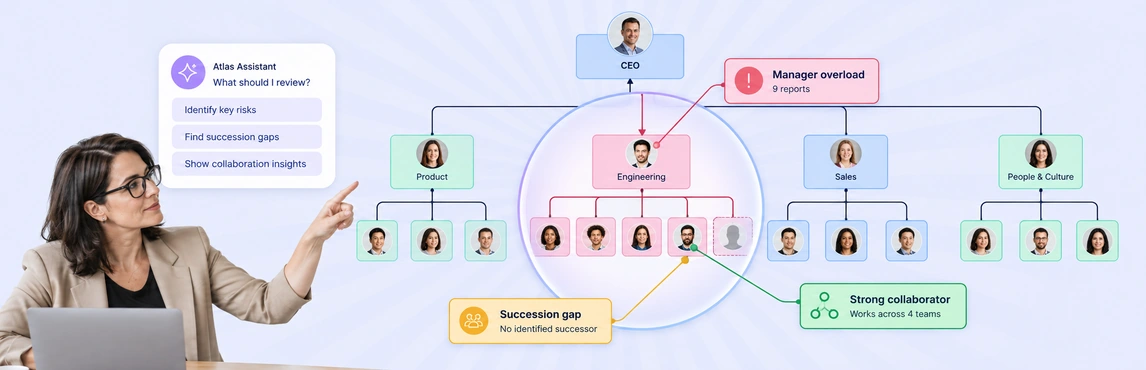
- Are manager spans and organizational layers still appropriate?
- Which succession gaps weaken continuity in key parts of the business?
- Which structural moves need approval now versus later?
A talent review may inform these answers, but the org review is about the system, not only the people inside it.
Why Leadership Teams Need a Regular Org Review Cadence
Without a cadence, organizational decisions become reactive. Teams patch vacancies, hire around unclear designs, and add layers or dotted lines without checking how the full structure is changing.
A repeatable review helps leaders:
- keep the organization aligned to the current plan;
- catch manager-load or team-design problems earlier;
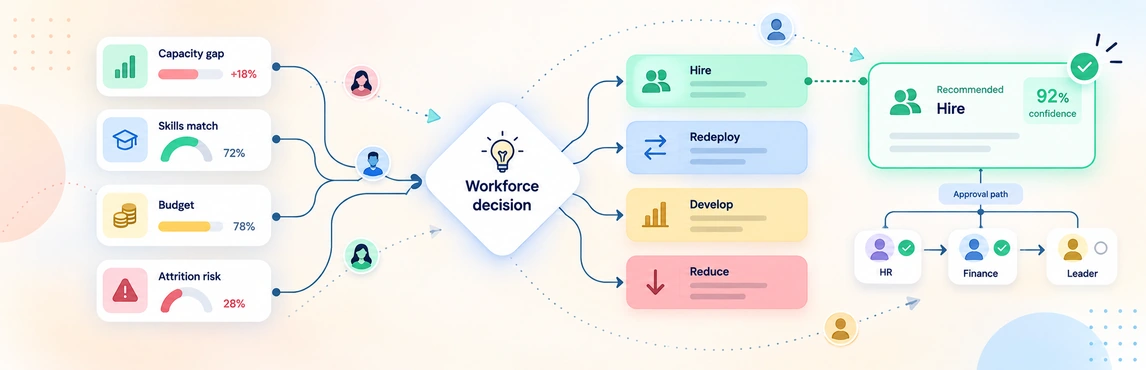
- connect headcount decisions to real structural context;
- review succession and continuity risk in the same conversation as staffing;
- create accountability for redesign, hiring, and follow-up actions; and
- avoid turning every issue into an emergency reorg.
How Often Should Org Reviews Happen?
The best cadence depends on how quickly the organization changes.
| Situation | Practical review cadence |
|---|---|
| Stable organization with moderate change | Quarterly deep review |
| Rapid growth or repeated team changes | Monthly operating review plus quarterly deep review |
| Active reorg or post-merger integration | Monthly or milestone-based review |
| Leadership transition period | Immediate review plus more frequent follow-ups |
| Annual planning cycle | Quarterly review with a deeper annual planning pass |
Consistency matters more than perfection. A lighter recurring review is usually better than a detailed framework that only happens once a year.
What to Include in an Org Review
Use one consistent set of decision inputs so leadership meetings stay comparable over time.
Include at minimum:
- the approved current-state organizational baseline;
- the planning horizon and scope for the review;
- key business changes since the last review;
- vacancies, approved hires, and paused or closed roles;
- manager spans and notable layer changes;
- critical-role or succession coverage concerns;
- open structural questions or scenario options; and
- the decisions required from the meeting.
Where appropriate, include links to span of control analysis, succession planning org charts, and headcount scenario planning.
How to Run Org Reviews for Leadership Teams
1. Confirm the baseline before the meeting
Every review should begin from one agreed current-state view. Confirm:
- which source provided the people and position data;
- when the baseline was last refreshed;
- what part of the organization is in scope; and
- which changes since the last review are already approved versus still proposed.
If the baseline is disputed, the meeting becomes a data-cleanup session instead of a decision session.
2. Organize the agenda around decision questions
Avoid open-ended “walk the chart” meetings. Use fixed questions such as:
- What has materially changed since the last review?
- Which areas show the greatest execution or continuity risk?
- Where are manager spans, layers, or role definitions drifting out of range?
- Which vacancies or approved hires require action now?
- What scenario or structural decision needs leadership approval?
This keeps the meeting focused on decisions rather than commentary.
3. Review structure and workload together
A team may look fully staffed and still be structurally weak. Review the chart alongside workload and management signals.
| Review lens | What to look for |
|---|---|
| Structure | unclear reporting lines, overlapping ownership, duplicated layers |
| Capacity | unfilled roles, delayed hires, concentrated workload |
| Manager load | unusually wide or narrow spans, overloaded leaders |
| Continuity | critical roles with weak bench strength or no coverage |
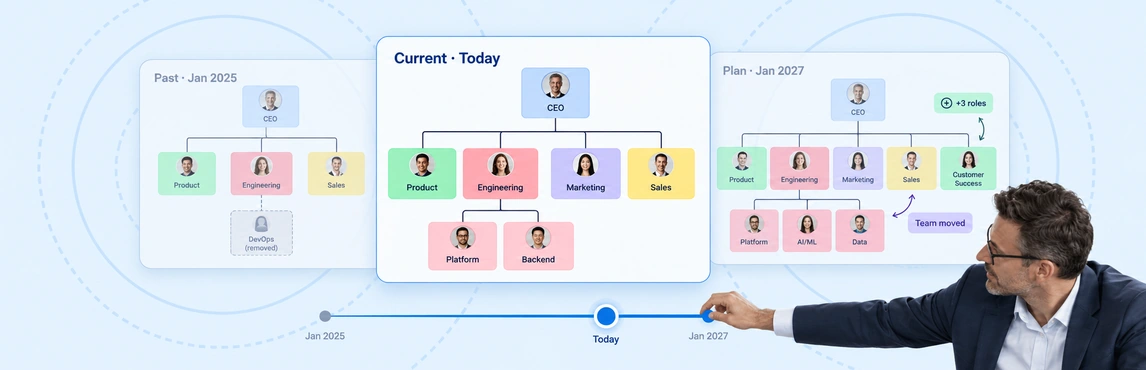
| Future-state change | proposed moves, redesigns, or scenario branches needing approval |
This is why org reviews work best with a visual and role-based organizational view, not only with headcount tables.
4. Keep sensitive detail permissioned
Not every leadership discussion requires the same workforce fields. A broader operating review may only need structure, vacancies, and spans. A smaller restricted review may need succession or role-criticality overlays.
Use the least amount of sensitive data needed for the decision. This keeps the conversation useful without widening access unnecessarily.
5. Assign actions before closing the review
A good org review ends with owned actions such as:
- open, hold, or redesign a role;
- review a team design or reporting line;
- address an overloaded span;
- run a targeted succession or talent follow-up;
- create a scenario comparison for the next review; or
- escalate a funding or governance decision.
Each action should have an owner and a review date.
What Strong Org Reviews Look Like
Strong org reviews have a few shared characteristics:
- one current-state baseline;
- a repeatable cadence;
- clear decision questions;
- visible comparison between current and proposed states;
- restricted handling for sensitive fields;
- actions tied to owners; and
- a clear separation between approved structure and hypothetical scenarios.
Common Failure Modes
Watch for these patterns:
- reviewing the same issues repeatedly without assigning action;
- using the org review as a substitute for data cleanup;
- discussing headcount without structure or structure without capacity;
- exposing succession or talent detail more broadly than needed; and
- allowing scenario changes to overwrite the approved current organization.
Where Atlas Fits in Leadership Org Reviews
Creately Atlas is designed as an always-current org-intelligence layer for HR and People leaders who need current organizational context without replacing the HRIS. In leadership org reviews, that positioning is useful when teams need:
- a current organizational baseline for review;
- scenario views that stay separate from the approved organization;
- historical views for before-and-after comparisons;
- governed collaboration across HR, Finance, and business leaders;
- field-pack style metadata for positions, planning status, and review context; and
- AI-assisted org analysis to help surface structural patterns or follow-up questions faster.
Atlas should complement the system of record rather than replace it. Use the HRIS for approved employee and position data, and use the org-intelligence layer to compare structure, risks, and decisions.
A Simple Org Review Template
Use this meeting structure to keep leadership reviews consistent:
- Baseline check: what changed since the last review?
- Risk scan: where are the biggest structural, hiring, or continuity pressures?
- Decision items: which teams or scenarios need leadership direction?
- Action log: what gets approved, deferred, or escalated?
- Next review date: when will the org be reviewed again?